
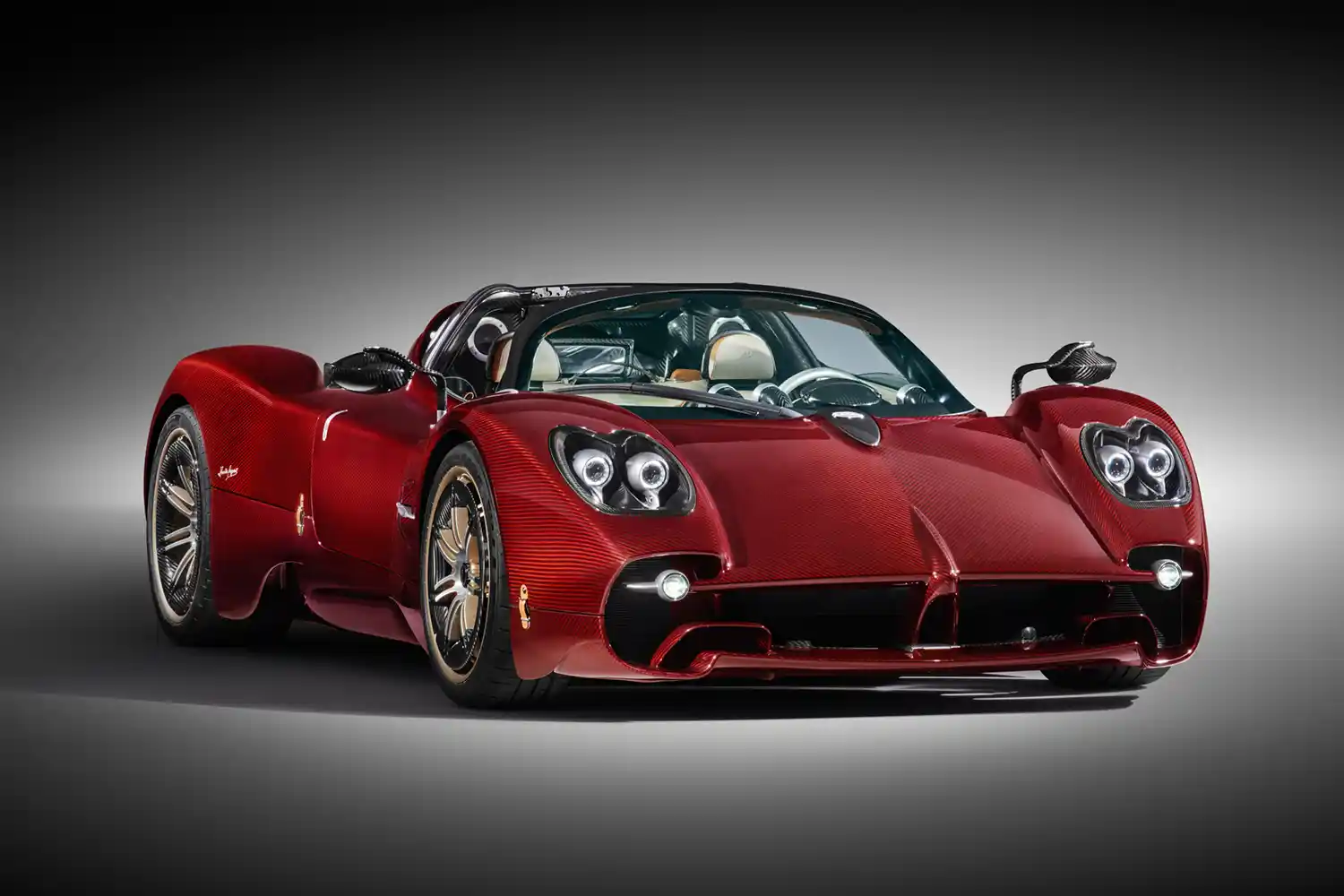
It's difficult to put into words what goes through your mind when you lay eyes on the latest flagship from the Italian luxury car manufacturer Pagani, the Pagani Utopia Roadster. What jewels are to women, untamed sports cars are to men, acting like predators you want to tame. It's pure fascination, true exhilaration that gets your blood pumping and inspires dreams.
Pagani specifically hired an experienced writer, Dr. Robert Puyal, to find the right words for the artwork. We are pleased to reproduce them here:
The roadster as the answer to the car lover's dilemma
Two years ago, Pagani Automobili unveiled the Utopia, a car whose name embodies the philosophy of relentless pursuit of perfection – an unattainable ideal that nonetheless spurs the developers on to achieve their best. Project C10, the Utopia's codename, was conceived with the pre-established duality of roadster and coupé in mind, building on the enthusiasm generated by previous models. Unlike the roadster versions of the Zonda and Huayra – which were developed after their respective coupé counterparts – the development of both variants proceeded in parallel.
How could the age-old dilemma of enthusiasts be better resolved? Gran Turismo fans have always debated which variant offers the purer expression: a closed or an open cabin. Both traditions boast a long history, and proponents of the two opposing options are often divided. The only way for Pagani to resolve this dilemma was to offer both versions and let the fans choose. Performance enthusiasts typically prefer coupes, as they are generally lighter and more agile. However, this criterion doesn't apply here, because the Utopia Roadster is just as light, dynamic, and powerful as its closed sibling.
The design of both versions demonstrates continuity and originates from the same team of designers and engineers – a team united by shared visions and working under the direction of Horacio Pagani in the Modena atelier. The doors feature the same elegant butterfly kinematics, a fascinating and sophisticated mechanism. Those who wish to drive under the open sky can place the hardtop on a stand, transforming it into a design object that invites contemplation and admiration. Additionally, there is a soft top that can be stored in a trunk, replacing the usual storage compartment located behind the two seats. The same car can thus be transformed into three different versions, each preferred depending on the season, mood, and whether one desires the comfort and protection of the interior or the open air and the gentle breeze on their face.
Im Utopia Roadster erinnern die Fußmatten mit ihrer besonderen Textur an ein Außenbordboot, und der Schlüssel wurde neu gestaltet und greift nun das Profil der offenen Version auf. Selbst mit geschlossenem Hardtop unterscheidet sich der lichtdurchflutete Innenraum dank eines großen Dachfensters deutlich vom Coupé. Ohne Hardtop erleben Fahrer und Beifahrer die Natur hautnah und genießen die einzigartige Landschaft mit ihren Gerüchen und den subtilen Temperaturveränderungen auf den Serpentinen.
Die nahezu unendliche Auswahl an Farben und Materialien für die Polsterung des Utopia Roadster gewinnt an Bedeutung, da der Innenraum ständig den Blicken der Passanten ausgesetzt ist. Aus dieser Kabine aus sehen Sie die Welt, und aus dieser Kabine aus sieht die Welt Sie.
The style of an object is defined, among other things, by the right accessories, and luggage is one of the features that further refines every Pagani hypercar. For the Utopia, there are two matching suitcases with leather-lined carbon fiber interiors, adorned with the emblematic Pagani ellipse. These can be stored in two special compartments next to the engine. They are true masterpieces of high-quality craftsmanship, where meticulous attention has been paid to every detail: from the selection of the leather, which either complements or contrasts with the vehicle's configuration, to the smallest details such as the hinges, the noise-dampening leather straps, and the footrests with the iconic quad-exhaust symbol. The accessory range is complemented by two matching garment bags, which are elegantly positioned behind the headrests in the Utopia.
The roadster underlines the high-tech performance of the Utopia.
Horacio Pagani is considered a pioneer of advanced composite materials. For nearly forty years, he has experimented with the most innovative solutions for his products. The first creation of the Pagani Atelier, the Zonda, was one of the first road cars with a carbon fiber monocoque body – a material then primarily reserved for the aerospace industry, Formula 1, and endurance racing cars. Thanks to continuous investment in research and development, Pagani Automobili has developed expertise that culminates in the Utopia Roadster. Current advancements go far beyond the use of carbon fiber; in fact, this hypercar utilizes over forty different composite blends. These include Carbo-Titanium HP62-G2 and Carbo-Triax HP62.
Thanks to state-of-the-art technology, the Utopia Roadster is just as light as the coupe, weighing in at a mere 1,280 kg (2,822 lb) (dry weight) – an incredible figure for a large V12-powered hypercar. This result was achieved through a completely redesigned monocoque chassis that optimizes rigidity and strength without the heavy reinforcements typically required when foregoing a roof.
Key objectives in the development of the Utopia were a low drag coefficient and significant aerodynamic downforce without protruding body parts. To achieve this, Pagani engineers conducted a detailed flow study in the wind tunnel. Air is precisely guided through the wheel wells, around the teardrop-shaped roof, and directed along the curved side profile. The airflow then flows around the exterior mirrors, over the hood, and down to the elliptical rear edge. There, two movable flaps, visible yet harmoniously integrated into the design, further enhance aerodynamics by adapting to varying driving conditions. The internal airflow for cooling and intake was also optimized down to the smallest detail, making a significant contribution to the vehicle's performance and stability.
From the outset, Pagani Automobili remained committed to the V12 engine and the collaboration with Mercedes-AMG, initiated by Juan Manuel Fangio, world champion with the German manufacturer and a supporter of Horacio Pagani's pragmatic vision. This continuity did not hinder progress: the team worked intensively on the version of the Pagani V12 for the Utopia. It is a true masterpiece of mechanics, lightweight and compact, developed in close collaboration with the AMG engineers responsible for its exclusive production for the Italian hypercar. Each engine is completely assembled by a single craftsman, a true artist of mechanics. The output of 864 hp (635 kW), comparable to that of many racing engines, does not fully do justice to the incredible versatility of this powertrain: it runs silky smooth at low revs and delivers explosive acceleration when the driver wants to experience the full power of the Pagani engine. The turbocharger's response is immediate, not least thanks to the enormous 1,100 Nm of torque, which is available exceptionally quickly. No heavy batteries, no hybrid system, just the wonderful roar of a V12 engine.
In collaboration with the British specialist Xtrac, Pagani developed a gearbox that effortlessly handles the torque of the twin-turbo V12 while ensuring smooth and pleasant operation under all conditions. The extremely compact seven-speed manual transmission, mounted transversely behind the engine, is connected to a lightweight and adjustable three-disc clutch.
The cutting-edge technology used in the processing of materials for the Utopia Roadster isn't limited to carbon fiber: the metal components are also of the highest refinement. The eight suspension triangles, forged from aircraft-grade aluminum, guarantee maximum strength while maintaining minimal weight. The revival of Modena Design, a long-established company owned by Pagani, now allows for complete control over every aspect of component manufacturing using aluminum, titanium, and special metals – from design and engineering to production using state-of-the-art technology, including the proven technique of solid-metal milling.
The Utopia Roadster impresses with exceptional agility and excellent cornering, guaranteeing an unparalleled driving experience in all conditions. The active suspension, combined with the electronic differential and dynamic control system, eliminates any understeer, while the electronic traction control ensures impeccable handling despite the enormous power. The Utopia Roadster offers breathtaking performance while remaining intuitively easy to operate. True to the Pagani philosophy, the driver never has to struggle with the car; it is always an inspiring, responsive, and trustworthy companion.
Pirelli, an essential partner of Pagani Automobili from the prototyping and simulation phase with the aid of the most advanced AI technology, is supplying the Utopia Roadster with exclusive tires equipped with advanced sensor technology on the inside of the tread that become points of interaction between the car and the road surface. Thanks to the Pirelli Cyber™ Tire, the tire’s sensors will send information to the vehicle’s stability control systems, including ABS, ESP, and traction control, to ensure maximum performance and the highest level of safety based on driving conditions. The Pirelli P ZERO™ Corsa and P ZERO™ Winter (standard) and the P ZERO™ Trofeo RS (optional), are fitments developed specifically for the Pagani Utopia, in size 21” at the front and 22” at the rear.
Every detail presents an aesthetic and technical challenge.
Inspired by the visionary genius of Leonardo da Vinci, who saw the union of art and science as the highest expression of human creativity, Pagani Automobili's work is relentlessly focused on uniting design, development, and manufacturing in an integrated process. Every aspect of form and function receives meticulous attention. Ergonomics are considered down to the smallest detail: every control is positioned exactly where you would expect it to be, comfortable to use, and designed with taste and a love for detail. Even a simple switch, whose shape, illumination, and precise operation are carefully considered, is as pleasing to the eye as it is efficient to use. Every single element contributes to a comprehensive visual and tactile experience, enriching every movement and making a drive in the Utopia Roadster a unique and unparalleled experience.
The Utopia's seven-speed manual transmission is a masterpiece of cutting-edge design, preserving traditional mechanics and operated via a classic gear lever with a titanium mesh. An object of supreme craftsmanship, it delights both visually and tactilely. Every single component of the highly visible mechanism is crafted with the utmost care and attention to detail, and the polished gear knob itself offers optimal grip. For those who prefer lightning-fast gear changes, the automated manual transmission (AMT) is available, controlled via steering wheel-mounted paddle shifters. Software strategies have further optimized speed and comfort, ensuring the driver feels equally at home on the road and on the racetrack. Pagani Automobili has always been dedicated to creating timeless designs, celebrating the elegance of manual operation as the purest expression of mechanical artistry. Since its inception, the company has embraced the enduring appeal of analog technology, refining the beauty and functionality of knobs, dials, buttons, and levers. Developing sophisticated components, such as a gearbox that meets the high demands of Pagani customers, presents an even greater technological challenge today than in the past.
The steering wheel is the very symbol of a car; the Utopia's is a symbol of Pagani's savoir-faire. No one has ever designed a steering wheel quite like it. Outwardly, it appears almost ordinary: however, the exceptional grip of the thick, leather-padded rim immediately catches the eye. But its uniqueness is revealed in the details: upon closer inspection, one sees that the rim, spokes, and hub are forged from a single piece of lightweight metal. Starting from a 43-kilogram block, a five-axis milling machine works continuously for 28 hours to produce this extraordinary object, weighing a mere 1.6 kilograms. The resulting scrap is reused as recycled material for other industries. A skilled craftsman meticulously finishes, polishes, and inspects each steering wheel by hand. The result is an exceptional achievement in both aesthetics and engineering.
The ambitions of the Utopia Roadster
One hundred and thirty examples of the Roadster will be produced and are destined for customers worldwide. The starting price is €3.1 million (excluding local taxes). An exceptionally dedicated community follows Pagani's creations with great interest. In this sense, the customers who will actually own the Utopia Roadster can be considered patrons of an art form that extends far beyond its exclusive circle, reaching even those who dream of one day owning a Pagani hypercar. The value of a technical and artistic creation is not measured solely by the number of orders: a sculptor addresses not only their client but also all who will enjoy their work. The Utopia Roadster, a true automotive sculpture in every sense, is eagerly awaited by admirers around the globe.
Since the very first models, a key component of the Pagani experience has been the offering of virtually endless customization options, allowing each customer to create a vehicle that expresses their uniqueness. The sheer number of available color and upholstery combinations makes it impossible for two Utopia Roadsters to be identical; each customer thus becomes a co-creator of their very own hypercar. Some prefer monochrome, others multi-colored combinations. Echoes of national colors or emblems from specific collections can be incorporated. The option to leave the carbon fiber exposed—either completely or only in certain areas, with or without colored paint—is among the aesthetic choices and reflects Pagani's philosophy. Technological aspects are not meant to be hidden; they are the artist's brush. Every part of the vehicle is designed to be both beautiful and efficient—beautiful because it is efficient. Art and technology go hand in hand, inextricably linked from the very first conception of the vehicle.
The Utopia Roadster will be officially unveiled at Monterey Car Week, an event that also includes one of the world's most prestigious Concours d'Elegance: Pebble Beach. Here, the most beautiful cars in history have been honored, deeply touching the senses and knowledge of enthusiasts and leaving a lasting impression.
Pagani entrusted the Utopia with the task of reconnecting with the past and reclaiming the simplicity often sacrificed in the name of sheer performance. This very simplicity, however, makes it an ally in experiencing the power of the V12, embodied in an elegantly styled hypercar that openly embraces iconic forms from the past. The designer drew subtle inspiration from automotive forms and other realms, such as the delicate profiling of Vespa headlights and accessories, the design of 1950s Italian Bianchi bicycles, and the curves of Riva speedboats. It is the deep mutual respect and friendship between Horacio Pagani and Carlo Riva that inspired the romantic lines of the Utopia – an admiration rooted in humanity and reflected in creativity. The Pagani Utopia Roadster is a meeting point of classic and modern design, a novelty that continues to stand out in the ever-denser panorama of ultra-high-performance sports cars.
Technical specifications | |
|---|---|
PERFOMANCE | 864 hp (635 kW) at 6,000 rpm at 18 °C |
TORQUE | 1,100 Nm from 2,800 to 5,900 rpm |
MOTOR | Pagani V12 60° 5980 cm³ twin-turbo engine,
developed for Pagani by Mercedes-AMG |
TRANSMISSION | Pagani by Xtrac 7-speed AMT (automated manual transmission) or fully manual, with electromechanical differential |
DRIVE | Rear-wheel drive |
CHASSIS | Monocoque made of Pagani Carbo-Titan HP62 G2 and Carbo-Triax HP62 with front and rear tubular frames made of CrMo alloy steel |
FEDERUNG | Forged double wishbone axle made of aluminum alloy with coil springs and electronically controlled shock absorbers |
BRAKES | Pagani by Brembo 4-disc brake unit made of ventilated carbon-ceramic discs, 410 × 38 mm with 6-piston monolithic calipers at the front and 390 × 34 mm with 4-piston monolithic calipers at the rear |
WHEELS | Forged monolithic aluminum alloy, 21-inch front and 22-inch rear |
TIRES | Pirelli P ZERO™ Corsa 265/35 R21 front and 325/30 R22 rear; Pirelli P ZERO™ Winter for driving in low temperatures |
DRY WEIGHT | 1,280 kg (2,822 lb) |
DIMENSIONS | Length 4,673 mm (184.0 in), width 2,060 mm (81.1 in), height 1,165 mm (45.9 in), wheelbase 2,796 mm (110.1 in) |
TOP SPEED | 350 km/h (217 mph), electronically limited |



 English
  Deutsch
  Français
  Español
  Italiano


